Teaching Students to Read Music: A Step-by-Step Guide for Music Educators
A practical sequence for helping beginners connect notation, sound, movement, and meaning.
Build music reading step by step by connecting direction, pulse, rhythm, a limited pitch set, fingering, sound, and meaningful performance. Read before playing and assess understanding in several ways.
Establish direction and pulse
Before naming notes, make sure students understand that music moves from left to right and is organized by a steady beat. Use pointing, tracking, movement, and simple rhythm patterns. Students who lose their place on the page often need stronger visual tracking and pulse before more note names.
Keep the first examples uncluttered.
Teach rhythm as a sound
Introduce a small set of note values and rests through speaking, clapping, stepping, and echoing. Then show the notation that represents those sounds. Move back and forth between ear and page so symbols remain connected to music.
Use one consistent counting system and apply it across the program.
Limit the first pitches
Begin with two or three notes that are comfortable on the instrument. Practice finding them, hearing them, and changing between them before expanding the range. Too many pitches at once can hide whether the student understands the staff.
Use patterns, not only isolated flash cards. Music reading requires recognizing direction and relationships.
Connect notation to fingering and sound
Students should be able to name a note, show the fingering or position, sing or imagine the pitch, and play it. Vary the response: point, finger silently, say, sing, write, and perform.
This prevents reading from becoming a single memorized pathway.
Read before playing
Give students a brief scan routine: check clef, key signature, time signature, first note, repeated patterns, rests, accidentals, and difficult measures. Count or finger the passage before adding sound.
A ten-second preview can prevent many stops.
Develop fluent reading
Fluency grows through frequent exposure to music that is slightly easier than the student’s maximum level. Include short sight-reading examples, duets, rounds, and familiar tunes. Do not make every reading experience a test.
Teach students to continue through small mistakes and recover at the next beat or measure.
Assess understanding in different ways
Ask students to write a rhythm, identify a note, correct an error, sight-read a short line, or explain what they notice. Varied assessment reveals whether the difficulty is visual, rhythmic, technical, or conceptual.
Books That Reinforce Step-by-Step Music Reading
These Music Fun Books series give teachers practical materials for introducing notation, limiting early pitch demands, and helping students progress toward independent reading.
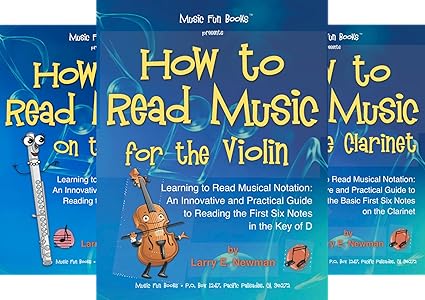
How to Read Music Series
This beginner-friendly series starts with the absolute basics and explains notes, rhythms, rests, key signatures, time signatures, accidentals, and sight-reading in clear language. Progressive exercises help students apply each concept to real music.
Best for: New readers, students with gaps in their understanding, private lessons, and classroom review. Instrument-specific editions are available for violin, flute, clarinet, and trumpet.
Explore the How to Read Music SeriesThe Real Book for Elementary Band Students
Each band edition contains 70 familiar songs using only six notes. Letter names appear inside the noteheads in the first half and are removed in the second half, creating a gradual bridge from supported note recognition to independent standard notation.
Best for: Elementary band classes, sectionals, private lessons, and home practice. Matching editions are available for flute, clarinet and trumpet, saxophones, brass, double reeds, and bells.
Explore the Elementary Band SeriesThe Real Book for Violin, Viola and Cello
This nine-book beginning string series also uses 70 familiar songs and six notes. Each edition concentrates on two adjacent strings, while the same two-stage notehead system moves students from letter-name support to genuine music reading.
Best for: Beginning violin, viola, and cello students in school orchestra, private lessons, or home practice. Separate editions cover upper, middle, and lower string pairs.
Explore the Violin, Viola and Cello SeriesThe Bottom Line
Students learn to read music when notation is consistently connected to sound, pulse, movement, and meaningful performance. Step-by-step instruction creates readers who are both accurate and independent.
Explore Music Fun Books
Find beginning and supplemental music books designed to keep young band and orchestra students engaged and progressing.