How to Choose the Violin Size for a Child
A properly sized violin is easier to hold, more comfortable to play, and much better for developing healthy technique. This guide explains violin sizes, how to measure your child, and how to recognize when an instrument does not fit correctly.
Choose a violin by physical fit, not by age alone. Measure your child’s arm, arrange a trial fitting, and ask a teacher or reputable violin shop to confirm the final size.
Your child should be able to hold the violin comfortably and reach the scroll without locking the elbow, raising the shoulder, or sharply bending the wrist.
Why the Correct Violin Size Matters
An incorrect violin size can make ordinary beginner challenges considerably harder. Proper fit gives a young musician the best chance to develop confidence, comfort, and healthy technique.
Comfort
The correct violin allows the child to support the instrument naturally without excessive stretching, twisting, or fatigue.
Healthy Posture
An oversized violin can cause a raised shoulder, locked elbow, bent wrist, and unnecessary tension in the neck, back, and arms.
Better Progress
A well-fitted instrument lets the student concentrate on bowing, rhythm, tone, listening, and expression instead of struggling to reach notes.
Common Violin Sizes for Children
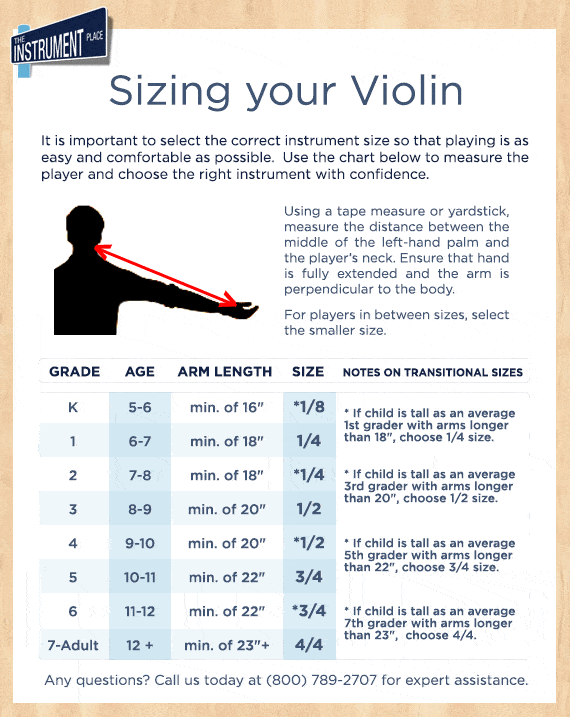
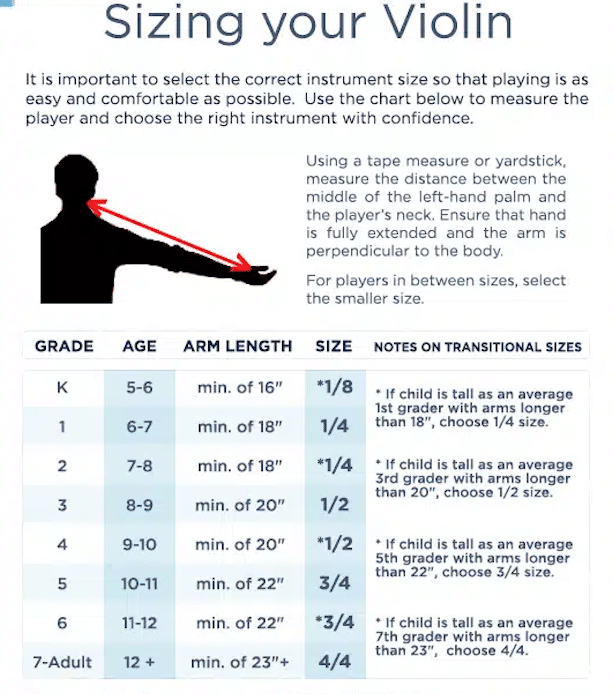
Age ranges are approximate. Children of the same age may need different sizes because arm length, hand size, height, and flexibility vary considerably.
Approximate Size Guide
Violin Sizing Chart
How to Measure Your Child
Extend the Left Arm
Ask the child to stand naturally and extend the left arm to the side. The arm should be straight but relaxed, with the palm facing upward.
Measure from Neck to Palm
Measure from the side of the neck to the center of the palm. Some teachers also use a shoulder-to-wrist measurement for a more conservative fit.
Arrange a Trial Fitting
Let the child hold the violin in playing position. A teacher or experienced shop employee should examine the reach, wrist, elbow, and shoulder.
The Scroll Test
Place the violin under the child’s chin and ask them to extend the left arm beneath the instrument. The fingers should be able to curve comfortably around the scroll. If the child must stretch, lock the elbow, or raise the shoulder, the violin is probably too large.
Signs the Violin Does Not Fit
The Violin May Be Too Large
- The child cannot reach the scroll comfortably.
- The left elbow becomes locked or fully extended.
- The wrist bends sharply while reaching notes.
- The shoulder rises to support the instrument.
- The violin feels heavy after a short practice session.
The Violin May Be Too Small
- The child’s left arm remains excessively bent.
- The instrument appears cramped against the body.
- Finger spacing feels crowded.
- The student recently had a growth spurt.
- The teacher recommends moving to the next size.
Practical Advice for Parents
Consider Renting
Young children often outgrow fractional violins. Many rental programs allow families to exchange the instrument for a larger size.
Ask the Teacher First
A violin teacher can evaluate posture, arm length, hand position, and comfort before you rent or purchase an instrument.
Do Not Buy to Grow Into
An oversized violin may cause strain and poor habits. Choose the size that fits the child now.
Check the Setup
The bridge, strings, pegs, bow, chin rest, and shoulder rest all affect comfort.
Review the Fit Regularly
Have the violin size checked at least once a year and after a noticeable growth spurt.
Use a Working Instrument
A damaged or poorly adjusted violin can make ordinary beginner tasks feel impossible.
Frequently Asked Questions
How often should the violin size be checked?
At least once a year, and sooner after a growth spurt or when the child begins to look cramped or uncomfortable.
Can a child grow into a larger violin?
No. An instrument that is too large can interfere with posture, comfort, reach, and healthy technique.
Is renting better than buying?
Renting is often practical for young beginners because fractional instruments can usually be exchanged as the student grows.
How do I know when it is time to move up?
The child may appear cramped, keep the left arm overly bent, or have crowded finger spacing. Ask the teacher to confirm.
What is the difference between 3/4 and full size?
A 3/4 violin is smaller and lighter. The correct choice depends on reach and comfort rather than age alone.
Can the shoulder rest change the size needed?
A shoulder rest can improve comfort and positioning, but it cannot make an oversized violin appropriate.
The Bottom Line
The best violin is the one that fits the child comfortably today. Use age charts as a starting point, measure carefully, arrange a trial fitting, and ask a qualified teacher to confirm the size. With a properly fitted instrument, a young violinist can focus on learning, progressing, and enjoying music.