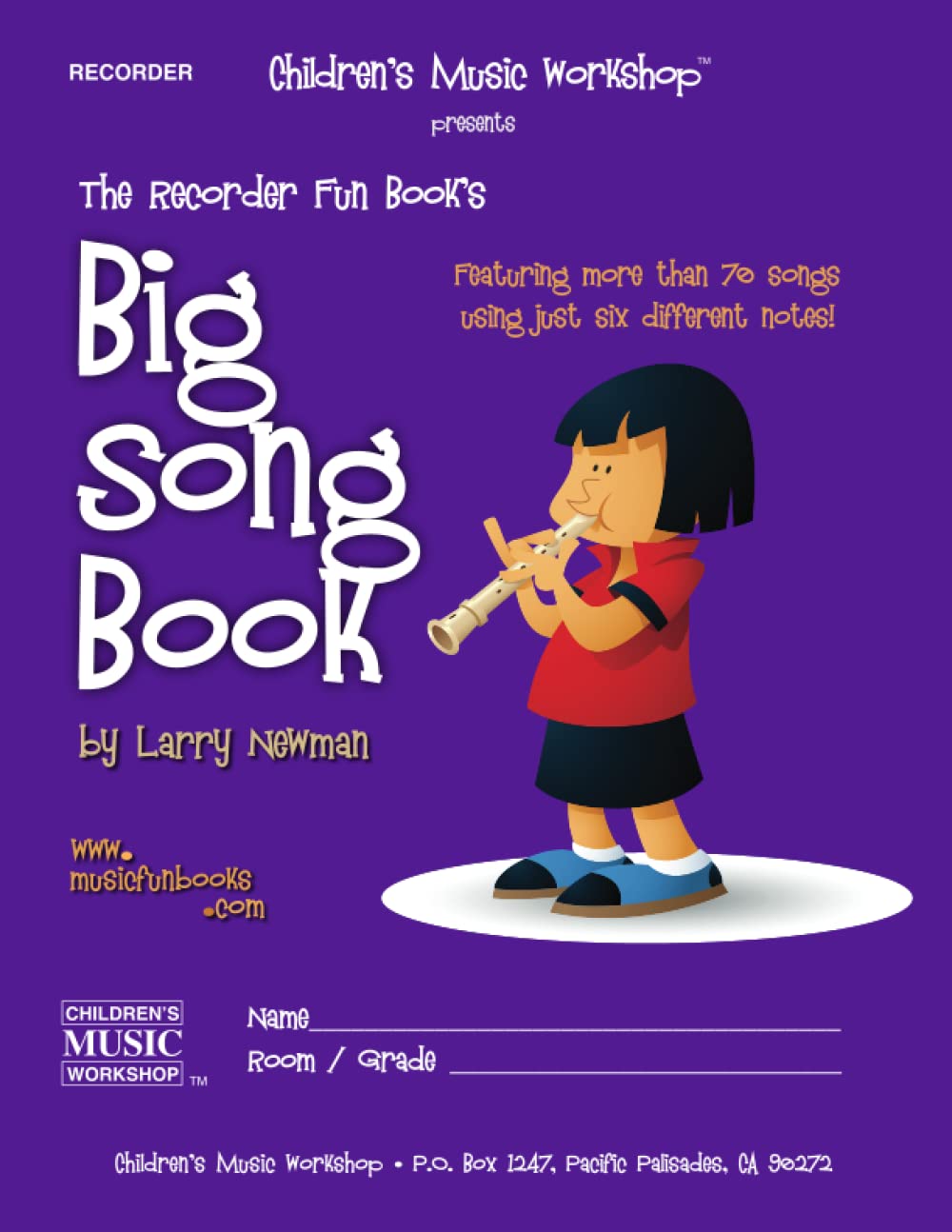
The Recorder Fun Book’s Big Song Book
More than seventy easy recorder songs built around just six basic notes. Students first play the music with letter names inside the noteheads, then return to the same familiar songs in standard notation as their reading becomes more independent.
- Large, clear notation for elementary students
- Uses only G, A, B, C, D and E
- Letter-name support in the first half
- Same songs repeated without letters
More Than 70 Songs. Six Recorder Notes. Two Ways to Read Them.
The Big Song Book gives a beginning recorder student much more music to play without continually increasing the number of fingerings the student must remember.
Songs to Explore
Traditional tunes, folk songs, classical themes, holiday favorites and other recognizable melodies.
Notes to Manage
Keeping the range to G through E lets students concentrate on rhythm, breath, tone and reading.
Reading Versions
The same repertoire first appears with letter names and then returns in regular music notation.
Play It With the Letters. Then Play It Without Them.
Students do not need to learn completely new repertoire at the same moment the reading support disappears. Instead, they return to music they already know.
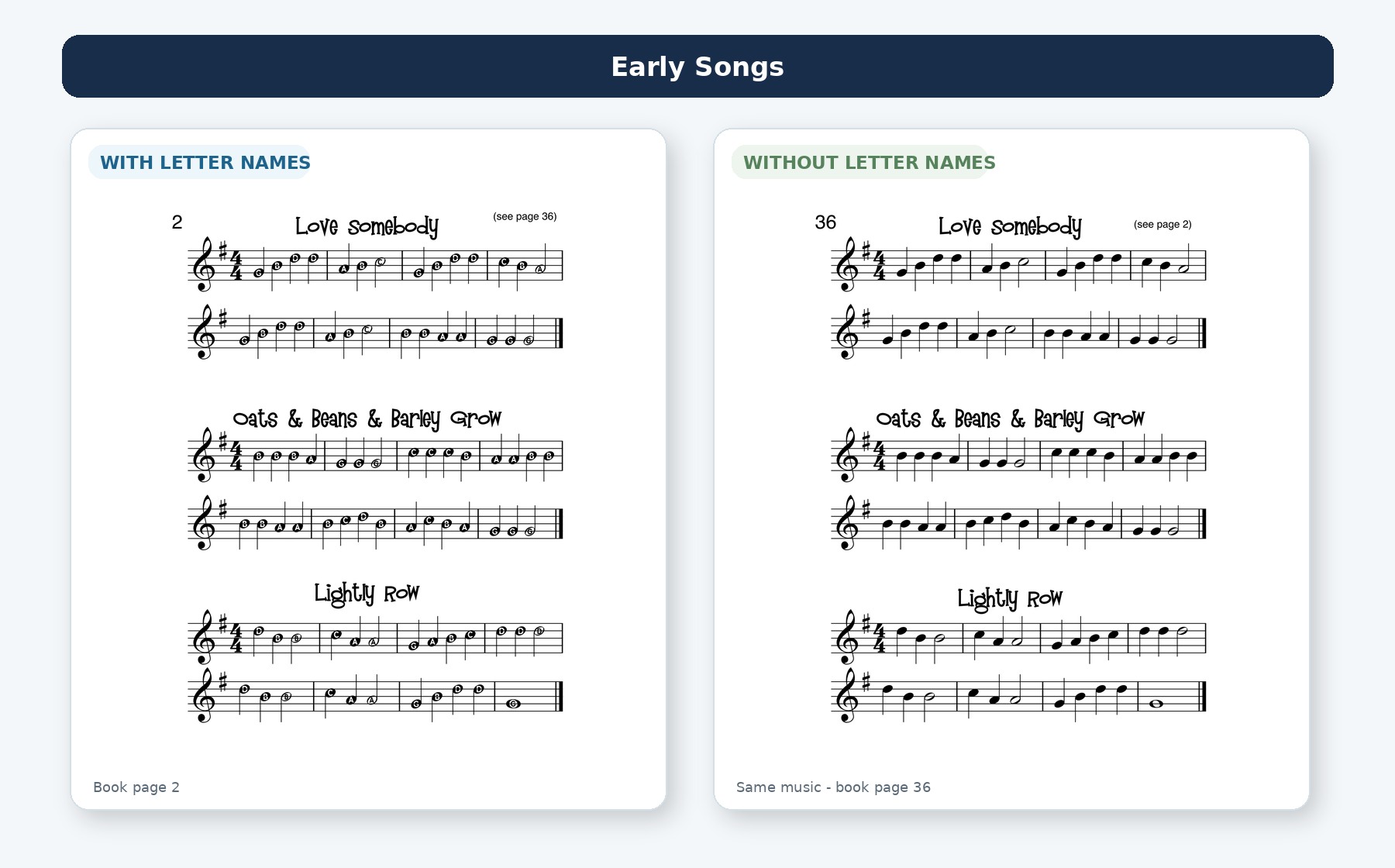
Letter Names Inside the Noteheads
Students can connect the written pitch with the recorder fingering while learning the melody and rhythm.
The Same Music Without Letters
The musical material stays familiar while students rely more directly on the staff and note positions.
The Same Recorder Music — With and Without Letter Names
These graphics use actual pages from the book. Click any comparison to open the full-size Media Library image.
 Open full size
Early Songs — Pages 2 and 36
Love Somebody, Oats & Beans & Barley Grow and Lightly Row
demonstrate the two reading versions very clearly.
Open full size
Early Songs — Pages 2 and 36
Love Somebody, Oats & Beans & Barley Grow and Lightly Row
demonstrate the two reading versions very clearly.
 Open full size
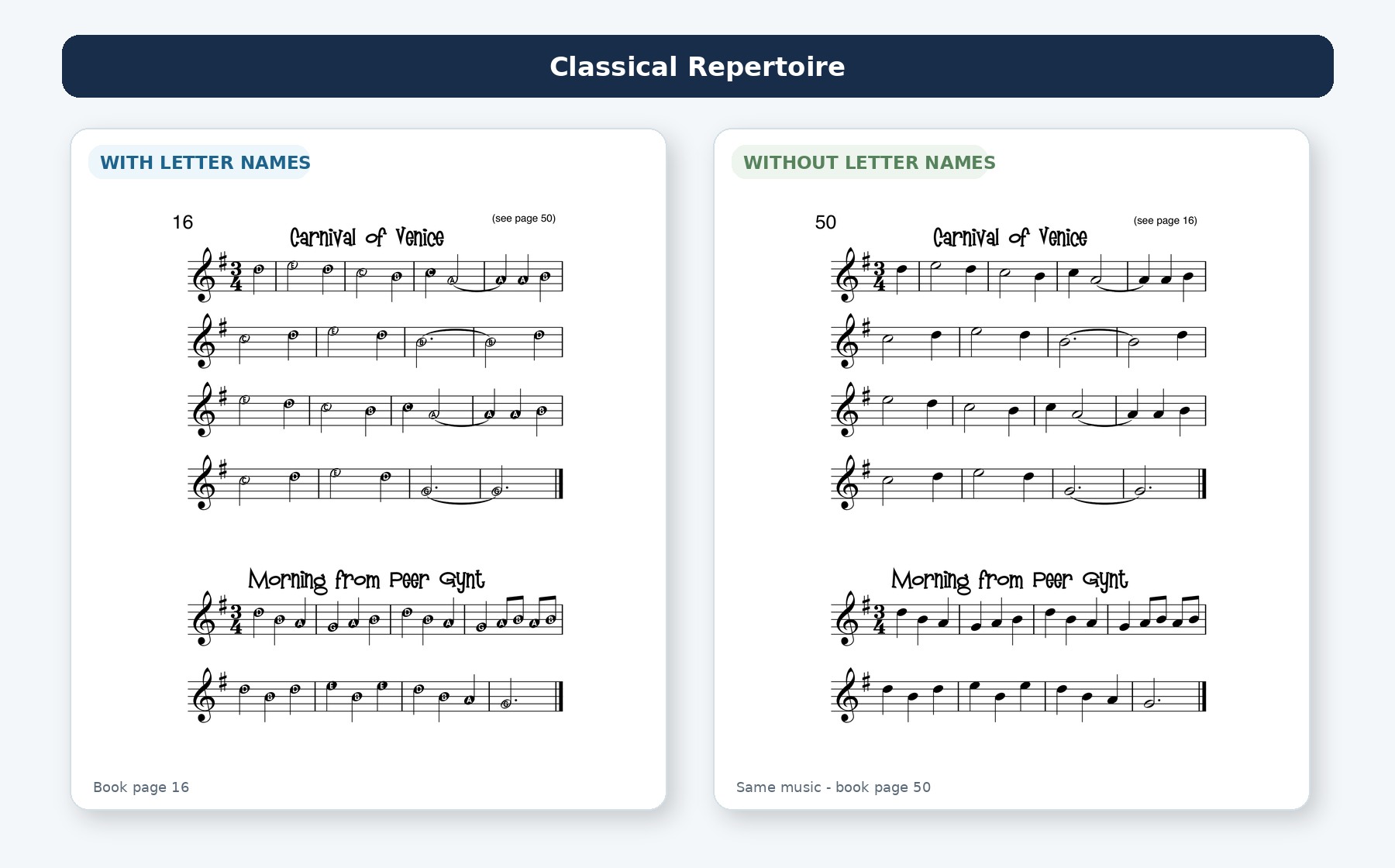
Classical Repertoire — Pages 16 and 50
Carnival of Venice and Morning from Peer Gynt show that the
six-note concept goes well beyond very simple children’s songs.
Open full size
Classical Repertoire — Pages 16 and 50
Carnival of Venice and Morning from Peer Gynt show that the
six-note concept goes well beyond very simple children’s songs.
 Open full size
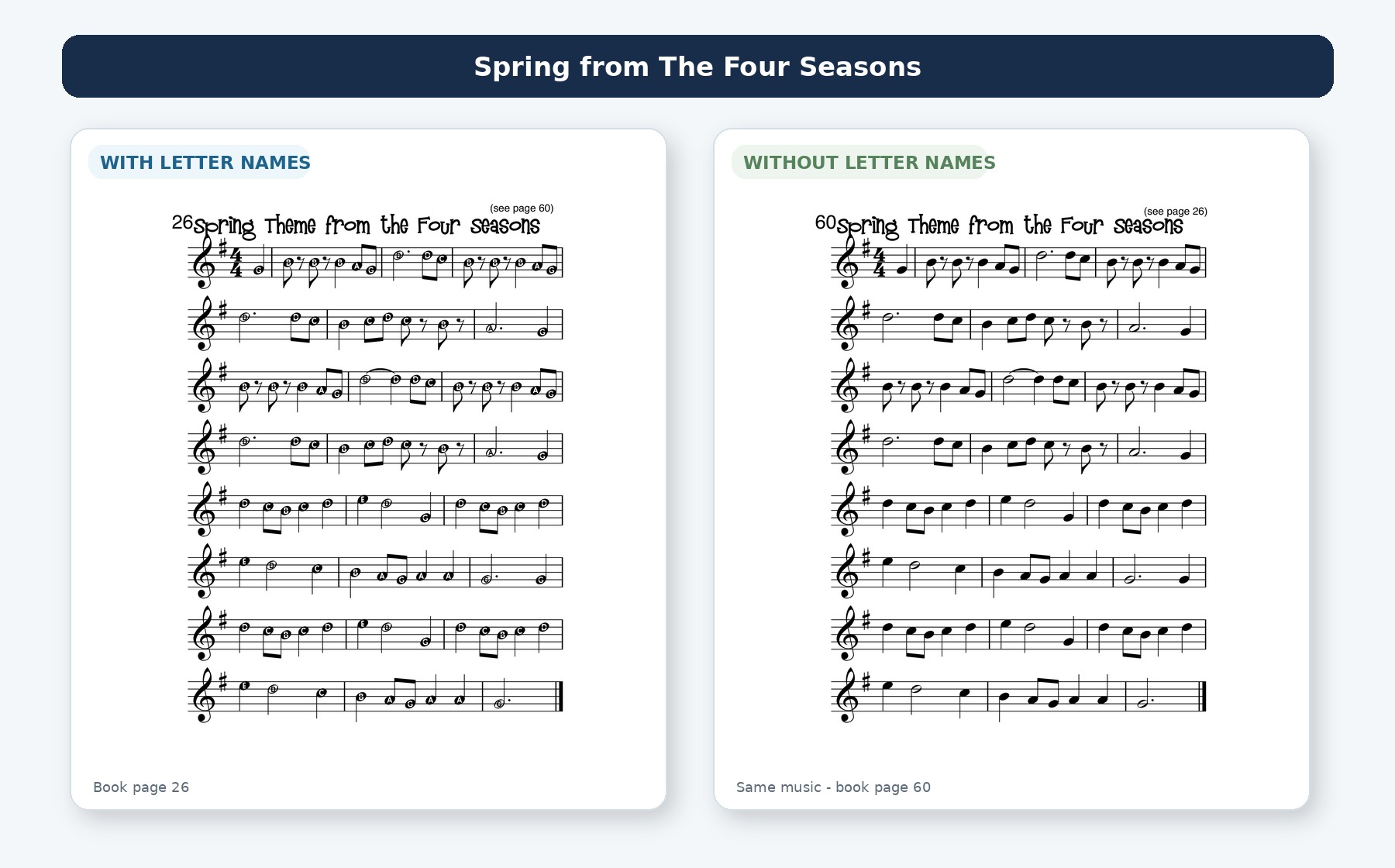
Spring from The Four Seasons — Pages 26 and 60
A more developed rhythmic example shows how substantial the
repertoire can become while remaining inside the same six-note range.
Open full size
Spring from The Four Seasons — Pages 26 and 60
A more developed rhythmic example shows how substantial the
repertoire can become while remaining inside the same six-note range.
More Music Without Constantly Adding New Fingerings
Young recorder players already have to think about finger coverage, breath, tonguing, rhythm and reading. A limited pitch range keeps the technical load manageable while allowing them to play a large amount of real music.
- Frequent repetition of important beginning fingerings
- More attention available for steady rhythm and clean attacks
- Repertoire variety without overwhelming the student
- A natural way to build confidence and reading fluency
Two Reading Levels Can Play the Same Song
One of the most useful features for teachers is that students at slightly different reading levels can work on the same musical material.
Developing Reader
A student who still needs visual support can use the version with letter names inside the noteheads.
Independent Reader
A student who is ready to read directly from the staff can use the matching version without letter names.
A Big Song Book Should Really Have a Lot of Songs
The repertoire ranges from the easiest beginning melodies to recognizable classical themes and rhythmically more developed music.
Beginning Favorites
- Hot Cross Buns
- Mary Had a Little Lamb
- Lightly Row
- London Bridge
- Twinkle, Twinkle, Little Star
Classical Themes
- Rondo alla Turca
- Morning from Peer Gynt
- Barcarolle
- Spring from The Four Seasons
- Ode to Joy
Folk & Traditional
- Aura Lee
- Camptown Races
- Frere Jacques
- Kum Ba Yah
- Oh, Susana
More Variety
- Saints Go Marchin’ In
- Jingle Bells
- This Little Light of Mine
- Trumpet Voluntary
- Largo from New World Symphony
Build a Recorder Library Around the Student
Method, Repertoire and the Next Challenge
The Big Song Book works particularly well as a large repertoire companion after students have learned their first recorder fingerings, or alongside a beginning method when additional songs are needed.
The Recorder Fun Book for Young Students
The flagship elementary method with large notation, fingering help, gradual pacing, familiar music and online play-along tracks.
Learn more Larger Beginning MethodBest Beginning Recorder Book for Kids
A broader beginning method with songs, scales, games, solos, duets and trios for elementary and early middle-school students.
Learn more More Easy RepertoireReally Easy Recorder Tunes
Another approachable song collection for beginning and early-intermediate players who want additional music to read.
Learn moreUse the Big Song Book in Many Settings
Recorder Class
Give an elementary class a large supply of familiar songs without introducing too many new fingerings.
Private Lessons
Add repertoire and sight-reading material alongside a regular step-by-step recorder method.
Differentiated Groups
Let developing readers use letters while stronger readers play the same song from standard notation.
Home Practice
Familiar tunes give young musicians a reason to pick up the recorder and play beyond the assigned lesson.

Why I Created the Big Song Book
Beginning recorder players need to repeat the same basic fingerings many times before those notes become comfortable. But students do not need to repeat the same exercise over and over to accomplish that.
By staying with six important beginning notes, I could give students a large number of different songs while they continued reinforcing the same essential recorder skills.
The two-version format also lets the book grow with the student. Letter names provide support when they are useful, and the same repertoire is waiting in standard notation when the student is ready.
Questions About The Big Song Book
Is this a complete beginning recorder method?
Which recorder notes are used?
Why are letter names printed inside the notes?
Do the letter names remain throughout the book?
Can students at different reading levels use the book together?
Does this book have the Recorder Fun Book audio tracks?
What age is the book intended for?
Give a Recorder Student a Lot More Music to Play
More than seventy songs, only six notes, and a built-in transition from letter-name support to standard notation.