Find the Right Violin Size for Your Child
A clear, parent-friendly violin sizing chart for choosing a comfortable beginner instrument before lessons begin. Use arm length, age, and teacher guidance to help select the best fit.
Sizing Your Violin
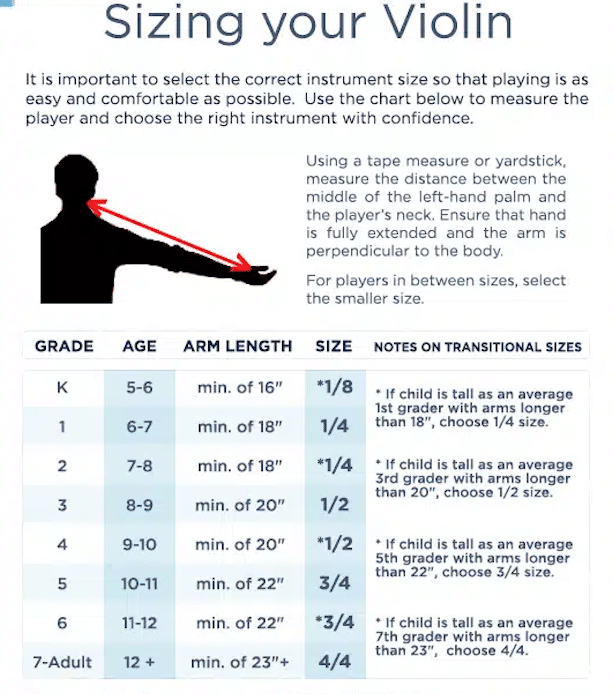
Measure from the neck to the palm or wrist with the arm extended, then choose a size that feels comfortable and easy to hold.
A properly sized violin makes the first lessons easier.
Beginning violin students need an instrument that is small enough to hold comfortably, but large enough to support healthy technique and a good playing position.
Use the chart to narrow down the likely size before renting or buying a beginner violin.
Measure at home so you can walk into a music store or lesson with a good starting point.
Share this guide with families who need a simple explanation of violin sizes and measurement options.
Measure from the neck to the palm or wrist.
Violins come in several sizes, from full size 4/4 down to very small beginner sizes. Most adults use a full-size violin, while children usually begin on a fractional size.
To estimate the best violin size, measure the distance between the player’s neck and the middle of the left-hand palm or left wrist. The arm should be fully extended and raised perpendicular to the body, similar to holding a violin.
Many teachers prefer the neck-to-wrist measurement because it often identifies the size that is more comfortable for a young student to hold. The neck-to-mid-palm measurement usually shows the largest size the student should use.
Common violin sizes for young beginners
This simplified table is based on the sizing chart. It is a helpful starting point, but a teacher or music store can confirm the final fit.
| Grade | Approx. age | Minimum arm length | Likely violin size | Notes |
|---|---|---|---|---|
| K | 5–6 | 16 inches | 1/8 | If the student is tall for the grade with longer arms, check the next size up. |
| 1 | 6–7 | 18 inches | 1/4 | A common beginner size for many early elementary students. |
| 2 | 7–8 | 18 inches | 1/4 | Some taller students may be ready for 1/2 size. |
| 3 | 8–9 | 20 inches | 1/2 | Choose comfort and good posture over using a larger instrument too soon. |
| 4 | 9–10 | 20 inches | 1/2 | Taller students may fit 3/4 size if the reach feels comfortable. |
| 5 | 10–11 | 22 inches | 3/4 | A common size for upper elementary students. |
| 6 | 11–12 | 22 inches | 3/4 | Some taller students may be ready for a full-size violin. |
| 7–Adult | 12+ | 23 inches or more | 4/4 | Most adults use a full-size violin. |
What to check after using the chart
The chart gives you a strong starting point. Before committing to an instrument, check comfort, reach, posture, and your teacher’s recommendation.
Simple fit checklist
- The student can hold the violin without strain.
- The left arm can reach comfortably without locking or over-stretching.
- The violin does not feel heavy or awkward under the chin.
- The teacher or music store agrees that the size is appropriate.
Once the size is right, choose music your child will enjoy.
Music Fun Books violin materials use clear layouts, beginner-friendly songs, and supportive resources for young students, parents, teachers, and school programs.


Violin sizing questions for beginners
What size violin does my child need?
Start by measuring from the child’s neck to the middle of the left-hand palm or left wrist with the arm extended. Then compare the measurement to the chart and confirm the fit with a teacher or music store.
Should I use the wrist or palm measurement?
The wrist measurement often points to the more comfortable size, while the mid-palm measurement usually shows the largest size a student should use. If a child is between sizes, many teachers prefer the smaller, easier-to-hold violin.
Do most adults use a full-size violin?
Yes. Most adults use a 4/4 full-size violin. Fractional sizes are mainly used for children and smaller students.
Should I buy a larger violin so my child can grow into it?
Usually no. A violin that is too large can make posture, hand position, and bowing more difficult. Comfort and proper technique are more important than growing into a larger instrument too soon.
What should we do after choosing a violin size?
Once the instrument size is comfortable, choose beginner-friendly music and practice materials. The Music Fun Books violin series is designed to make first lessons clearer and more enjoyable for young students.
Help your young violinist begin with confidence.
Use the sizing chart to choose a comfortable instrument, then explore beginner violin books, free samples, and helpful learning resources from Music Fun Books.